


In recent years, the used car warranty market has continued to expand as motorists look for ways to help manage the potential cost of unexpected repairs.
While many providers operate responsibly and provide clear information about their products, there have also been occasional examples of short-lived businesses appearing online that later cease trading or fail to meet customer expectations.
For this reason, it is increasingly important for motorists to understand what to look for when choosing a warranty provider, and how to identify businesses that offer both transparency and long-term support.
What matters most when choosing a warranty provider:
- Years of experience and trading history can provide useful context when comparing warranty providers.
- Independent reviews often give insight into real customer experiences.
- Clear information helps explain what a warranty includes and excludes.
- A clearly explained repair process can help customers understand what to expect if a repair is needed.
- If a warranty plan seems too good to be true, take time to check the provider is legitimate.

What to check before you buy:
Choosing a warranty provider is not simply about comparing prices – it also involves understanding how the provider operates, how repairs are assessed and how clearly the product is explained before purchase.
The checklist below outlines they key points to review before making a decision:
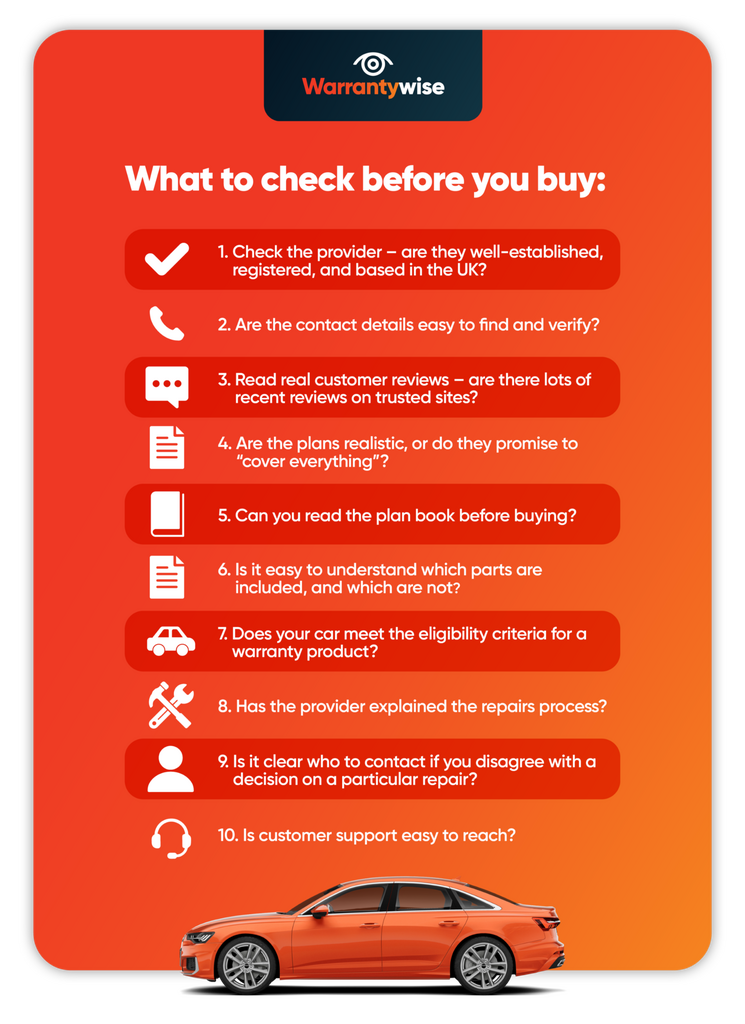
Why provider experience matters:
Are you getting a quote from a long-standing specialist with years of experience, or a little-known brand?
While no single factor should determine your decision, longevity in the market and a provider’s track record often reflects valuable experience and stability.
Providers that have operated for many years are likely to have supported a wide range of vehicles and customer needs, helping them develop clearer plans and more practical processes.
Established providers also tend to have a larger volume of independent customer reviews, making it easier to assess real-world customer experience rather than relying on limited testimonials.

What customer reviews can tell you:
Customer feedback offers valuable insight into how a warranty works in practice.
When reviewing feedback, consider:
- The number of reviews.
- How recent the reviews are.
- Which websites the reviews are hosted on.
A high volume of up-to-date reviews suggests an active provider with ongoing customer engagement. Comments that explain how issues are handled can be particularly useful.
Check where reviews are hosted. Independent platforms such as Trustpilot and Feefo are generally more reliable than testimonials published solely on a company’s own website.
Look for balanced feedback that discusses:
- How easy it is to request a repair.
- Easy of communication with the provider.
- Overall satisfaction.
While reviews can offer valuable insight, it’s also worth taking a few practical steps to confirm a warranty provider is genuine.
A quick background check can help customers feel more confident before committing to a purchase.

Understanding who you are buying from:
Not all used car warranty providers offer the same level of transparency. Before purchasing, it’s worth taking a few simple steps to check the provider is genuine and well-established.
Customers should consider:
- Checking the registered address to confirm it exists and matches a real business location.
- Searching the company on Companies House to ensure it is registered, active and trading under the correct name.
- Verifying contact details, including a working phone number, email address and customer support options.
- Being cautious of vague promises, such as “covers everything” or “no exclusions”, as reputable providers explain limitations clearly.
A reliable provider should be transparent about who they are, how their warranty works, and the processes customers can expect if a repair is needed.
As a general rule, if a warranty plan seems unusually good compared to others available, it’s worth taking a moment to verify the provider and the warranty plan in more detail.
When a warranty plan appears unusually generous:
Warranty products are designed to manage risk within defined parameters.
Plans that appear unusually cheap or promise ‘unlimited cover’ should be reviewed carefully, as reputable providers explain their plans clearly.
Taking time to review the plan documentation and understand how decisions are made can help avoid misunderstandings later.

What happens if your car needs a repair:
When comparing warranty providers, it is worth understanding how repairs are handled in practice.
Established providers will be more than happy to explain the repair process clearly before you buy, including how garages contact the provider, how repairs are authorised and how payments are handled.
Look for providers that clearly explain:
- How a repair request works.
- Who you need to contact.
- Whether you can use your preferred VAT-registered garage.
It’s also important that customers understand what to do if they disagree with a repair request decision. Clear guidance on how to raise concerns or request a review of a decision is another sign of a transparent and customer-focused provider.
Clear communication matters. Accessible customer support, whether by phone or online, can help make the repair request process easier to navigate.
What may or may not be included in your plan:
Clear and accessible information is essential when choosing a used car warranty. You should be able to review plan details before purchasing and have easy access to the plan book.
For discretionary used car warranties, each repair request is considered in line with the warranty plan. This should be explained clearly, using straightforward language, so you understand how the warranty works before you buy.
Vague wording or overly technical language can make it difficult to understand what you are agreeing to. A reputable provider will outline what is included, what is excluded and any limitations upfront, rather than hiding key details in complex small print.
Understanding exclusions and limitations before you buy:
It is important to pay close attention to exclusions and limitations. For example, some warranty providers may support consequential damage, subject to the warranty plan.
Consequential damage is any damage that happens as a result of an initial mechanical failure. If an eligible part fails and, as a direct result, causes damage to the engine, the engine damage may be described as consequential damage.
Some warranty providers may support this type of damage, subject to specific terms of the warranty plan, while others may not – so it’s important to check how it is treated in the plan book.
Wear and tear (also referred to as consumables) is typically excluded from many warranty plans. Understanding these distinctions can help set realistic expectations before you buy.
You should also be able to easily find plan books, review parts lists, and check key information such as servicing requirements and garage labour rates. This information should be easy to find, clearly explained and available before purchase.

How vehicle eligibility affects your warranty options:
Not all vehicles are eligible for warranty products, so it’s important to understand the criteria.
In reality, extended warranties are available for most vehicles, subject to age, mileage and condition. Providers with clear eligibility criteria help set realistic expectations.
Thinking about long-term value and support:
When comparing warranties, it’s worth considering not just what’s being promised today, but whether the provider has the experience and infrastructure to support customers over time.
Warranties are designed to help when something goes wrong, often months or even years after purchase, so long-term reliability matters.
A trustworthy provider should aim to explain processes clearly, making their warranty accessible and straightforward to understand. This includes being honest about what the warranty can and cannot do, rather than relying on bold promises or exaggerated claims.

Why experience and transparency matter:
Understanding the principles laid out in this article can make it easier to recognise providers that prioritise clarity, consistency, and long-term customer support.
It can also help customers identify whether a warranty provider is established, transparent, and operating legitimately.
With over 25 years in the industry, having served millions of motorists across the UK and rated Excellent by over 15,000 customers on Trustpilot, Warrantywise has built its reputation on transparency and long-term support.
Our focus on clear information and accessible customer support reflects the importance of helping customers understand their warranty before they buy.
Further information on our used car warranty options is available on our website, including clear plan details, eligibility criteria, and what’s included.
Important information:
The information provided is for general informational purposes only and does not constitute legal, financial or professional advice.
Discover more.
Further Warrantywise articles you might find useful

What’s the difference between consumer rights and a warranty?
(Approx: 5 min read) Consumer rights are the built‑in legal protections you always have when you buy something, so you’re … Continued

What you need to know about car warranties – Do you really need one?
Many UK drivers hear about extended warranties, but what do they really mean, and why are they important? A car … Continued

How can warranties help you budget for unexpected repairs?
The new year has arrived, and what better time to embrace a fresh start by taking charge of your finances. … Continued